
by Nathan Miller, CEO, Transco Products Inc.
The United States is at an inflection point. Electricity demand is rising faster than at any time in decades, driven by advanced manufacturing, electrification and the explosive growth of artificial intelligence. At the same time, we are striving to strengthen energy security, reduce emissions and rebuild domestic industry.

Nathan Miller, CEO, Transco Products.
The question is not whether we need more power. It’s whether we will build it here in America—or fall behind. The answer should be clear: we must build more nuclear energy, and we must do it now.
I recently returned from Washington D.C., where I joined more than 40 U.S. suppliers in meeting with Congressional members to share the importance of building nuclear plants in the U.S., specifically the benefits of deploying Westinghouse’s advanced AP1000® modular reactor. As the only fully licensed, construction-ready advanced reactor available today, the AP1000 plant is ready to deliver real economic benefits to the nation.
Two AP1000 units are already in commercial operation at Plant Vogtle, near Waynesboro, Georgia, each generating enough electricity to power an estimated 500,000 homes and businesses. This project demonstrates that large-scale nuclear can be built in the United States, and that we have the workforce and supply chain that is ready to do it again.
Illinois can play a leading role in this nuclear renaissance. Our state has one of the longest and most influential histories of nuclear power in the United States. On December 2, 1942, a team led by physicist Enrico Fermi achieved the first self-sustaining nuclear reaction in Chicago as part of the Manhattan Project, proving that nuclear energy could be controlled and laying the foundation for the entire commercial nuclear power generation industry.
In the early 1950s and 1960s, Illinois became a center for nuclear reactor innovation with researchers at Argonne National Laboratory and at Fermi National Accelerator Laboratory designing many early reactor concepts. During the 1970s and 1980s, Illinois experienced a massive nuclear power plant buildout, making Illinois the nation’s leading producer of nuclear energy. Today, nuclear power still provides roughly half of our state’s electricity.
Now we are on the cusp of another nuclear era in the United States, with a national effort to deploy a fleet of AP1000 reactors underway. These new plants will do more than meet rising electricity demand—they can revitalize American manufacturing and create sustained economic growth for decades.
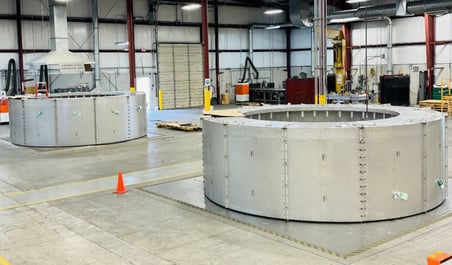
Transco Products manufactures insulation for the advanced AP1000® modular reactor, including this insulation needed for the reactor vessel.
For small- and medium-sized manufacturers like Transco, which supplies critical thermal insulation products to all of America’s nuclear plants, this presents a huge economic opportunity. Nuclear construction is not a single project; it is an ecosystem. When we build reactors, we also build factories, supply chains and careers.
An independent analysis from PricewaterhouseCoopers underscores the scale of this opportunity. Building a 10-unit AP1000 fleet could generate more than $92 billion of gross domestic product (GDP) for the U.S. and support 44,300 high-paying jobs annually for 13 years. Over the life of these plants, the economic impact exceeds $1 trillion, with 22,500 sustained jobs each year over their 80-year lifetime.
At Transco, we have seen these impacts firsthand. We have partnered with Westinghouse since the beginning of nuclear energy in America. It is a partnership that has endured, where Transco was involved in the AP600 design—the forerunner of the AP1000 reactor—and supplied all insulation materials for Plant Vogtle Units 3 and 4. It takes us up to two years to manufacture insulation for a single AP1000 reactor, increasing our factory workforce and driving demand for engineers and skilled trades to install our insulation products. At Vogtle, Transco had up to 100 qualified union insulators from across the U.S. on site over a span of 10 years—workers who contributed directly to the local economy through housing and support of local businesses during the extended period they were on the project.
So, imagine the sustained economic impact of building 10 new units in the U.S. It would anchor a long-term industrial ecosystem, supporting workforce development, stabilizing domestic manufacturing and strengthening U.S. competitiveness globally.
Illinois was instrumental in building the first generation of America’s nuclear fleet. With Westinghouse’s AP1000 plant, we have the opportunity to build the next. If we lead, we can secure not just our energy future, but our economic strength and national competitiveness for generations to come.
Click here to learn more about the AP1000.